How to Use Google Drive, Dropbox and OneDrive in ComfortFiles
Updated November 10, 2026
Every cloud drive whose Mac app you have installed — Google Drive, Dropbox, OneDrive or Box — sits in the sidebar beside iCloud Drive, under its own name. There is nothing to connect: ComfortFiles shows the files the drive’s own app keeps on your Mac, and that app does the syncing, exactly as it does for Finder.
Where they appear
- In Quick Access, next to iCloud Drive. A drive you set up while ComfortFiles is open shows up at once.
- Google Drive opens straight into My Drive when that is all there is at its top, so there is no extra folder to click through.
- Two accounts of the same drive — a personal and a work Google account, say — sit under one Google Drive row, each named by its account.
- Inside a drive, the address bar starts at the drive: Google Drive › Photos, just as the sidebar names it.
Like any built-in row, a drive can be hidden from Quick Access and shown again — see Quick Access.
Which files are on this Mac
A file kept only in the cloud carries a small cloud at the end of its name, as in Finder. In the icon view the cloud sits on a round badge at the corner of the picture. The file still shows its size, and a Google Drive file its thumbnail — without being downloaded just to draw it.
It comes down when you open it, or when you select it with the preview panel open — only the file you selected, never the ones around it. While it comes, a ring fills in beside its name and the preview says how far it has got.
Files on their way up are marked the same way. A file you copied into a drive that has not reached the cloud yet carries a cloud with an up arrow; while it uploads, a ring turns in its place; once it is up there, the mark goes. If the drive refuses it — its storage is full, or it does not accept the name — an orange warning takes the mark’s place, and pointing at it says why. So a file that shows nothing is in the cloud as well as here.
A video waits to be asked. Selecting it shows its picture and a Play button — so arrowing through a folder of films brings none of them down. From Google Drive and Dropbox it streams: press Play and it starts within seconds, and only the part you watch comes down. From other drives the button says how much it downloads, and the video plays once it has. A video played this way stays in the cloud, so it asks again the next time. To keep one on your Mac, press Download — among the preview panel’s buttons, or in its right-click menu beside Free Up — and the ring on its row fills while the whole file comes down.
Give the room back without deleting anything
Downloaded files take room on your Mac. Giving them back to the cloud frees that room and deletes nothing: the files stay in your drive and come down again the next time you open them. ComfortFiles calls it Remove Offline Copy; Finder calls the same thing Remove Download.
- One file or folder: right-click it and press Free Up, the button under the top row (its full name, Remove Offline Copy, shows when you point at it).
- Everything a drive has downloaded: right-click the drive’s row in the sidebar and choose Clear Downloaded Files…. You are told how much room comes back before anything happens.
- Across all your drives at once: the Cloud downloads group in Storage lists what came down from Google Drive, iCloud Drive, Dropbox and OneDrive, largest first.
A file you are looking at in the preview panel is let go first, so it goes back to the cloud with the rest rather than coming straight back down. A file another app has open — selected in a Finder window with its preview showing, or a video playing in QuickTime — cannot go back while it is open; ComfortFiles tells you which files stayed, and they go the next time once that app has let them go.
iCloud Drive lets files go only while Optimize Mac Storage is on. With it off, iCloud keeps a copy of every file on your Mac and refuses to remove one — ComfortFiles says so and opens the setting for you: System Settings ▸ Apple Account ▸ iCloud ▸ Drive ▸ Optimize Mac Storage. Any other drive that is set to keep its files on this Mac is told the same way; that setting is in the drive’s own app.
Keep files only in the cloud
Photos and videos you rarely open can live in the cloud alone, the way they would on a home server. Paste or drag them into a folder of Google Drive, Dropbox or iCloud Drive and ComfortFiles asks once: Only in the Cloud, or Keep on This Mac Too. To answer once for every time, choose it in Settings ▸ General ▸ Copying to a cloud drive: Ask every time (as it comes), Keep only in the cloud, or Keep on this Mac too — the question itself says where.
- Only in the Cloud puts them in the drive as usual, then waits: each file leaves this Mac as soon as the drive has it — nothing is removed before. Copied files leave their originals where they were; moved ones are in the cloud alone.
- More than this Mac has room for — a few hundred gigabytes of video from a flash drive onto a Mac with fifty free — goes in turns: the next files are sent as the first ones leave. The question says so before anything starts.
- If the drive refuses one — its storage is full, or it does not accept the name — that file stays on this Mac, and you are told which and why.
- Opening such a file here downloads it again; your phone and other computers open it straight from the drive. The Google Drive and Dropbox apps play a video as it streams.
The work shows in the File operations window, with Cancel; quitting while files are still on their way asks first, since their copies here would stay. iCloud Drive with Optimize Mac Storage off keeps every file on this Mac, so there the question is not asked.
How full is the drive
Hover over a drive in the sidebar. A Google Drive account shows how much of your Google storage is used and how much is free, counted the way Google counts it. Every cloud drive, Dropbox and iCloud Drive included, shows how much of it is downloaded to this Mac. iCloud does not tell other apps how full your iCloud storage is — that figure is in System Settings ▸ your name ▸ iCloud. While that is being counted the tooltip says Calculating…; it is counted afresh each time you hover, so a file you have just downloaded is included.
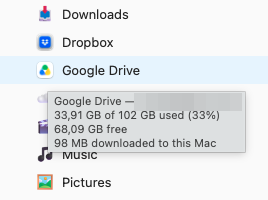
Disks under My Mac answer the same way: used, free and the percentage.
When the drive’s app is not running
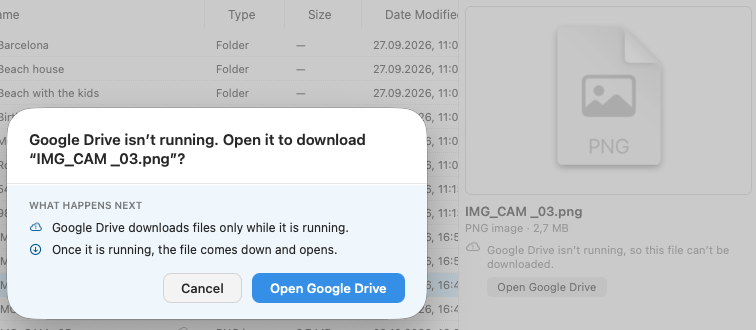
A cloud drive’s files come down only while its app is running. If you have quit Google Drive — or it has not started yet — the preview panel says so under the file’s name and offers Open Google Drive; once it is running, the file comes down and is shown. Opening such a file, or pressing the space bar on it, asks the same question first. Nothing is lost in the meantime: the file is safe in the cloud.
Related
- Quick Access — pin, reorder and hide the rows at the top of the sidebar.
- Find what is taking up space — including what your cloud drives have downloaded.
- The preview panel — see a file without opening it.
Frequently asked questions
Does ComfortFiles work with Google Drive, Dropbox and OneDrive?
Yes. Every cloud drive whose Mac app you have installed — Google Drive, Dropbox, OneDrive or Box — appears in the sidebar under its own name, beside iCloud Drive, the way Finder lists them. There is nothing to sign in to: ComfortFiles shows the files the drive's own app keeps on your Mac, and that app does the syncing.
How do I free up space from Google Drive on my Mac without deleting files?
Right-click the Google Drive row in the sidebar and choose Clear Downloaded Files…. Everything the drive has brought to this Mac goes back to the cloud: the room is freed, nothing is deleted, and each file comes down again when you open it. For a single file or folder, right-click it and press Free Up.
What does the small cloud next to a file name mean?
That the file is kept in the cloud and not on this Mac, as in Finder. It still shows its name, size and — for Google Drive — its thumbnail. Open it, or select it with the preview panel open, and it comes down; a ring fills in while it does. A video waits until you press Play.
How can I see how full my Google Drive is?
Hover over the drive in the sidebar. A Google Drive account shows how much of your Google storage is used and how much is free, counted the way Google counts it; every cloud drive, iCloud Drive included, shows how much of it is downloaded to this Mac.